
Click here to listen to this episode on Mark’s podcast “JAM: Just a Moment with Mark Silver”
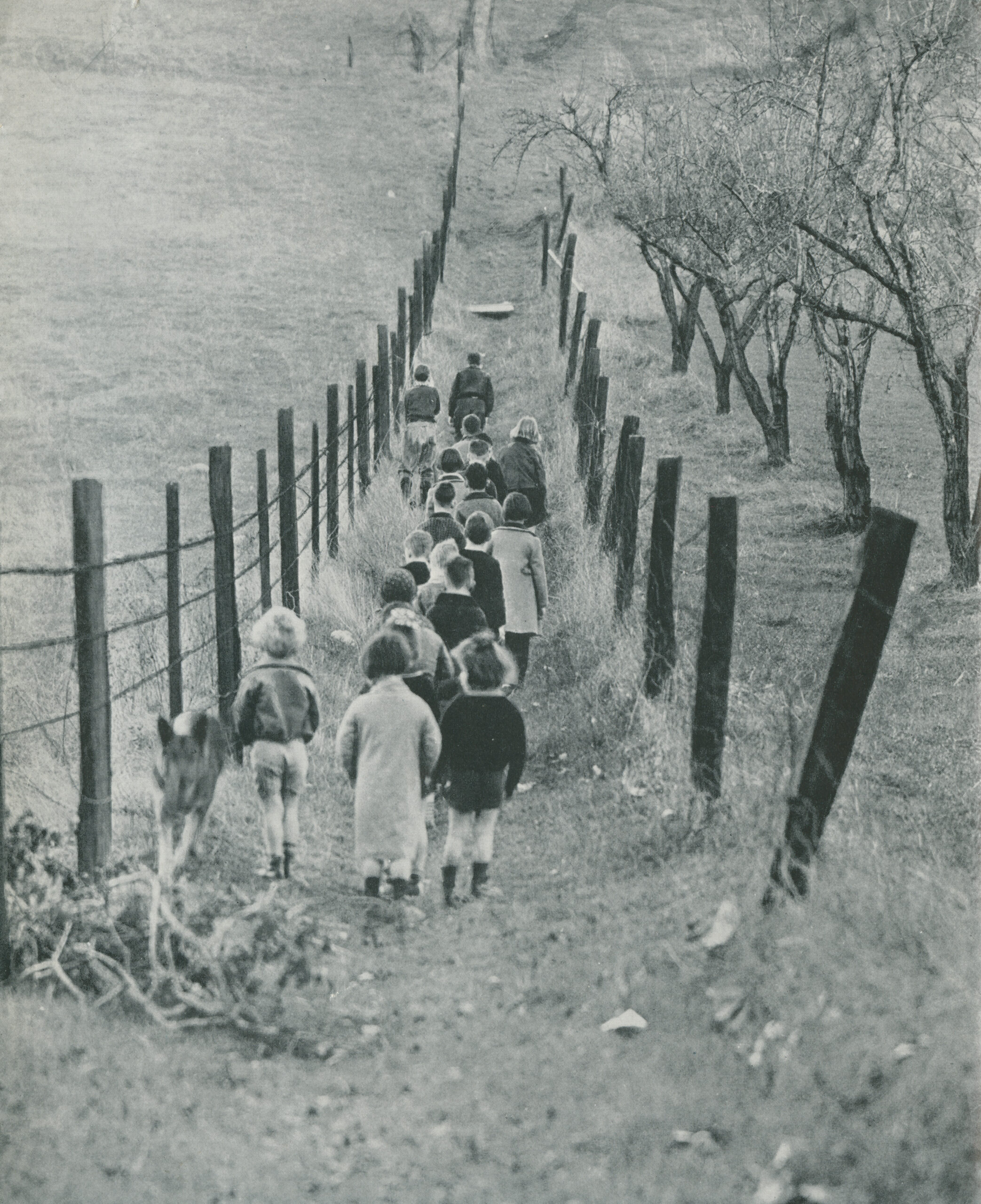
It’s one of the school’s more iconic images, although perhaps one that only a few contemporary community members have seen. Seventeen children dressed in their finest outfits walking in a single file line alongside the back part of the Los Gatos campus. The year is 1935. And the children are there with two of our founders, Mary Orem and Natalie Wollin, meeting with the owners of the property – the Parker family – in an effort to persuade them to sell the property to this brand-new school. According to historical accounts, the young children sang, danced, and played musical instruments for the Parker’s family, inspiring them and leading Colonel Parker to “just melt.” Within days the property was sold to the burgeoning school. The rest, as they say, is history.
Over the ensuing 90 years, The Children’s Country School, a little boarding school with 17 students and a unique and compelling vision for what education could and should be for all children, evolved into what we now know as Hillbrook School, with three divisions, two campuses and more than 480 students from across the South Bay.
This summer, as we have been thinking about how best to launch the 2025-26 school year and celebrate our 90th anniversary, I have been drawn back to the school’s early years, and reminded yet again of how the foundations of what we do today are so deeply rooted in that place and time. An early viewbook from the 1940s shows images of Middle School aged students in small-group discussions that ensure “individual progress” and round table groups “where we discuss affairs and build attitudes.” Photos of students building bookends and mending chairs, performing plays and vocal music, and conducting research at the local public library highlight the breadth of the academic program. A caption under a photo of two students performing a musical piece together emphasizes that “when we play well enough we may perform together, that’s one reason why we practice so hard,” a reminder that creating authentic ways to showcase your learning is the secret to generating engagement and helping students develop the resilience to accomplish hard things. The viewbook also highlights our youngest learners, showing photos of how the children learn “the value of struggle and the joy of victory” as they master the art of tying their shoes, take “early steps in mathematics and reasoning…in the little community kitchen,” and find “hidden treasures in each busy day,” including discovering “polliwogs in the creek.”

Undoubtedly the most visible foundation from our early years is the Village of Friendly Relations, which sits at the heart of the Los Gatos campus. Built by our earliest students, the Village of Friendly Relations grew out of founder Mary Orem’s audacious desire to help students imagine and create the conditions for world peace, a critical need in a late 1930s world experiencing the rise of fascism. The student-led village included a general store, a bank, and a newspaper office (The Happy Times). The Village even inspired an article in Sunset magazine, providing national recognition for the leading edge educational experience the school offered.
One of my favorite keepsakes is a ledger from 1941 that includes the names of the students and shows how much money they had in their account. Looking through the ledger you can see that some students managed their money pretty well – Noel Crandell went from $.12 to $1.23 from February through July in 1941, while others were not quite as savvy – Walter Moses started with $.20 in February and the ledger simply writes “gone” following a debit on April 7. There is a reference to a Bread Project, and sections devoted to what would appear to be the Bank’s own resources, with Checks and Cash on Hand, Notes Receivable, and Customer Overdrafts all noted. Over the course of this 6 month period, it is clear that students were engaging in real commerce and banking. The Village was a working village.

Last Spring, a small group of 10th graders created a new business – the Eco-Bear Collective – which is focused on creating a market for secondhand clothes. Launched with several pop-up appearances at Hillbrook community events, they have been both creating a business and spreading a message of how this business model is better for the community and the world. Check out their Instagram account to learn more about the why behind secondhand clothes, upcycling, and an alternative to fast fashion, and also to be kept apprised of when they might pop up next. Just like Noel, Walter, Peggy (she had $.18 left as of July 30!) and others in the early 1940s, these students were learning lessons that go way beyond the traditional classroom. And, just like those students of the 1940s, the community and culture of the school created the conditions for this type of experience to happen.
This is just one of myriad examples of ways in which your children – the Hillbrook students of today – are benefitting from the vision of our founders. Even as we grow and expand – the ribbon cutting for the Classroom & Administrative Building on our San Jose campus is this Friday! — the core of who we are and why we exist has not changed. And, there is no doubt that the type of education we are providing is even more relevant and important than it was in the 1930s and 1940s. In a time of rapid change in which students are being prepared for a world we cannot yet imagine, the education we offer at Hillbrook – an education that embraces purpose, pathways and challenge – is the best way to ensure that the students in our care today will be prepared to thrive and be the leaders of tomorrow.
Welcome back to school, Hillbrook community. Our 90th year just may be the best one yet!
So glad to see this glimpse of the founding principles of Hillbrook. I will use these as I work to compliment my grandchildren’s experiences at Hillbrook. Zion and Caperton Henderson