The Awesome World of Making @ Hillbrook

Stories of Making and Constructionist Learning

Category: Middle School Makers (5-8th) (page 1 of 3)

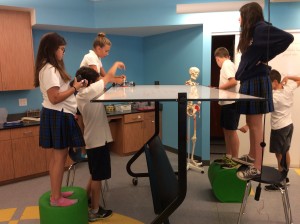
Witness the awesomeness of what kids can do when given the opportunity to direct their own learning in science, math and engineering. In 2012, we redesigned the 5th and 6th grade science curriculum to be taught in a maker space full time. Classes are now process, rather than content driven, with an emphasis on analog and digital making, tinkering and fixing. Using problems as prompts, students are allowed to work on solutions for long periods of time using the tools of digital and analog making. Problem based science is taught to 5th grades all year in science class. In the iLab, the 5th graders are presented with Prompts (basic rules or criteria for pass/fail) for the three of four possible units of study. Unit One is Materials (material science), Unit 2 is Patterns (asking questions, measurement, data visualization and logic), Unit Three is Structures (engineering and design) and Unit Four is Systems (interdisciplinary science). Problem based Science can be extended into all of middle school in short term projects as well as in our iLab hosted electives in seventh and eight grade.

Computational Thinking, Robotics and Programming 6-8th Grade

Why robotics?

Robotics is a form of learning STEM (science, technology, engineering, math) that exercises several aspects of hand and brain development for a learner. Assembling a structure from LEGOs, or laser cut or 3D printed parts is step one. This part of design and engineering is obvious to most of us, but there also lies a deeper level of learning when students begin to program their own objects to perform tasks.

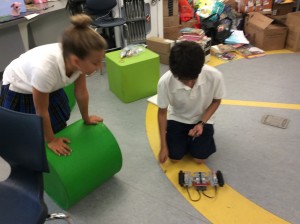
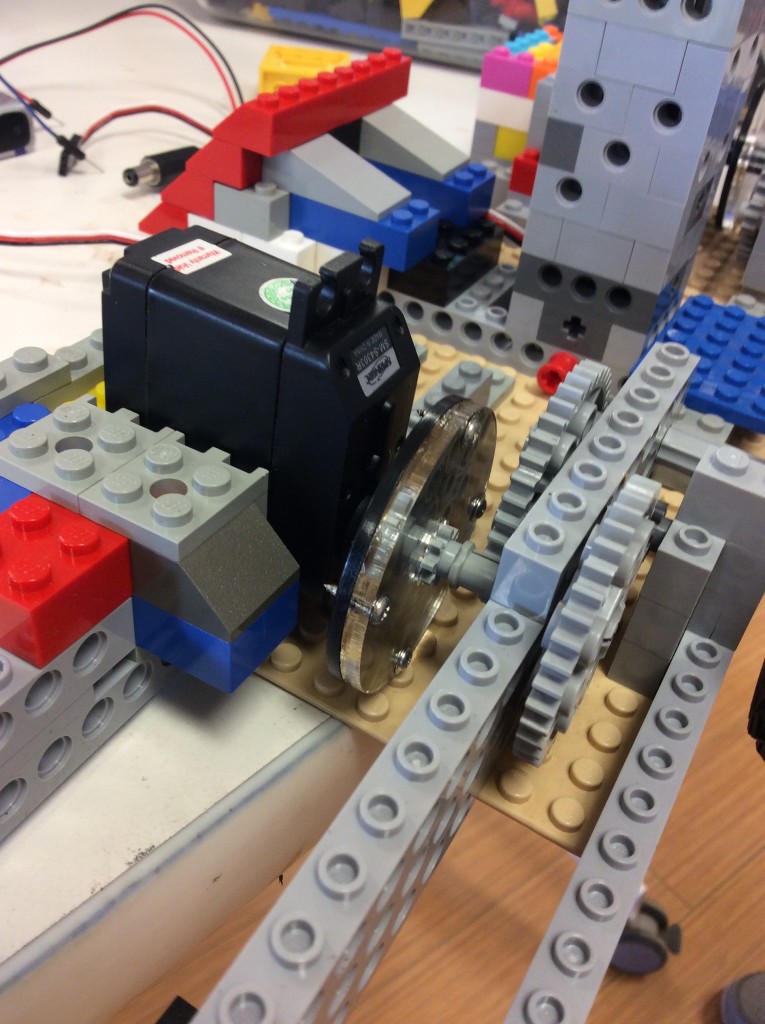
Hillbrook students come to middle school with a range of experiences using technology, programming and building. To level the playing field and to ensure that every middle school student has access to the benefits of robotics, design and programming, 6th grade science teacher Ilsa Dohmen spends several weeks in the spring using LEGO NXT Mindstorm kits to introduce her students to computational thinking, building and programming. Beginning with a challenge where students are given most of what they need to build a working robot except wheels, students learn the basics of [If, Then] programming. These challenges included programming the assembled robots to drive one meter forward, any distance backward, make a square, and make a circle with a large diameter.

During this unit Dohmen reports that “students encountered new concepts and tough problems, including the existence and function of an axle, the ideal amounts of friction between axle and wheel versus axle and motor, different ways to balance weight of the body on the motor arms, and how to stabilize wheels that wobble or slip on the floor. After the initial mechanical challenges, students particularly found the programming of the square hard work. Even after discovering a method for making a right angle turn, many groups found that imbalances and imperfections in the physical bot made repeating the same code for each turn insufficient; the same code repeated had reduced effects (e.g. resulting in the first turn being right angled and subsequent turns usually being not sharp enough).”
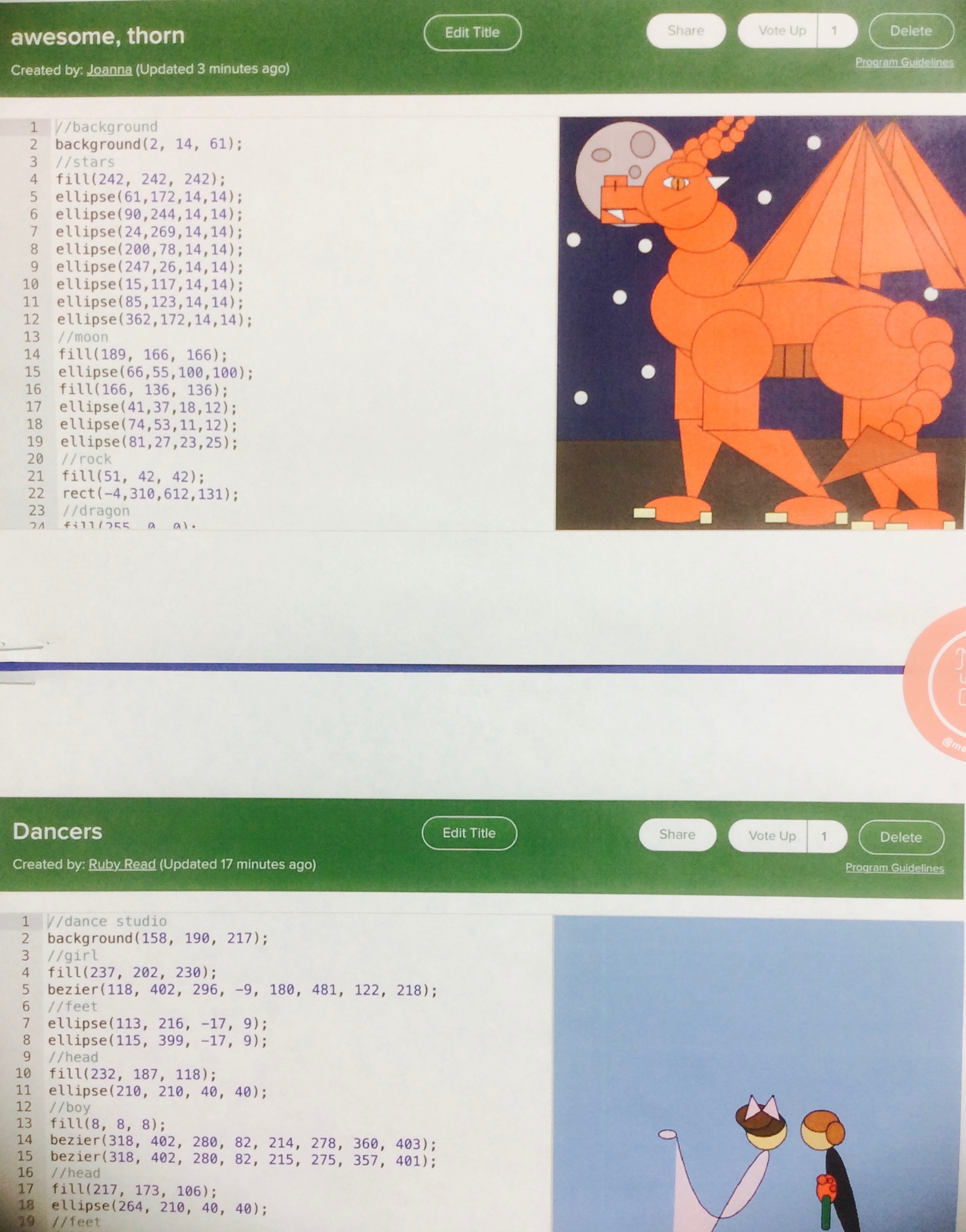
IMG_0032 (1)

5th grade projects on display in the 5/6 math room. Here students used Codeacademy to make unique art.

Thanks to new math teacher Chris Cabrera, the 5th and 6th graders were using Codeacademy in math class this fall. When the vast majority of programming jobs only require middle school level math knowledge, it is refreshing to see the use of nontraditional modes of expressing and exploring math through programming.  8th grade geometry students have also been introduced to the use of the programming language Python to create turtle art patterns which mimic fractals. These programs can then be sent to the school’s laser cutters and printed into compelling works of art.
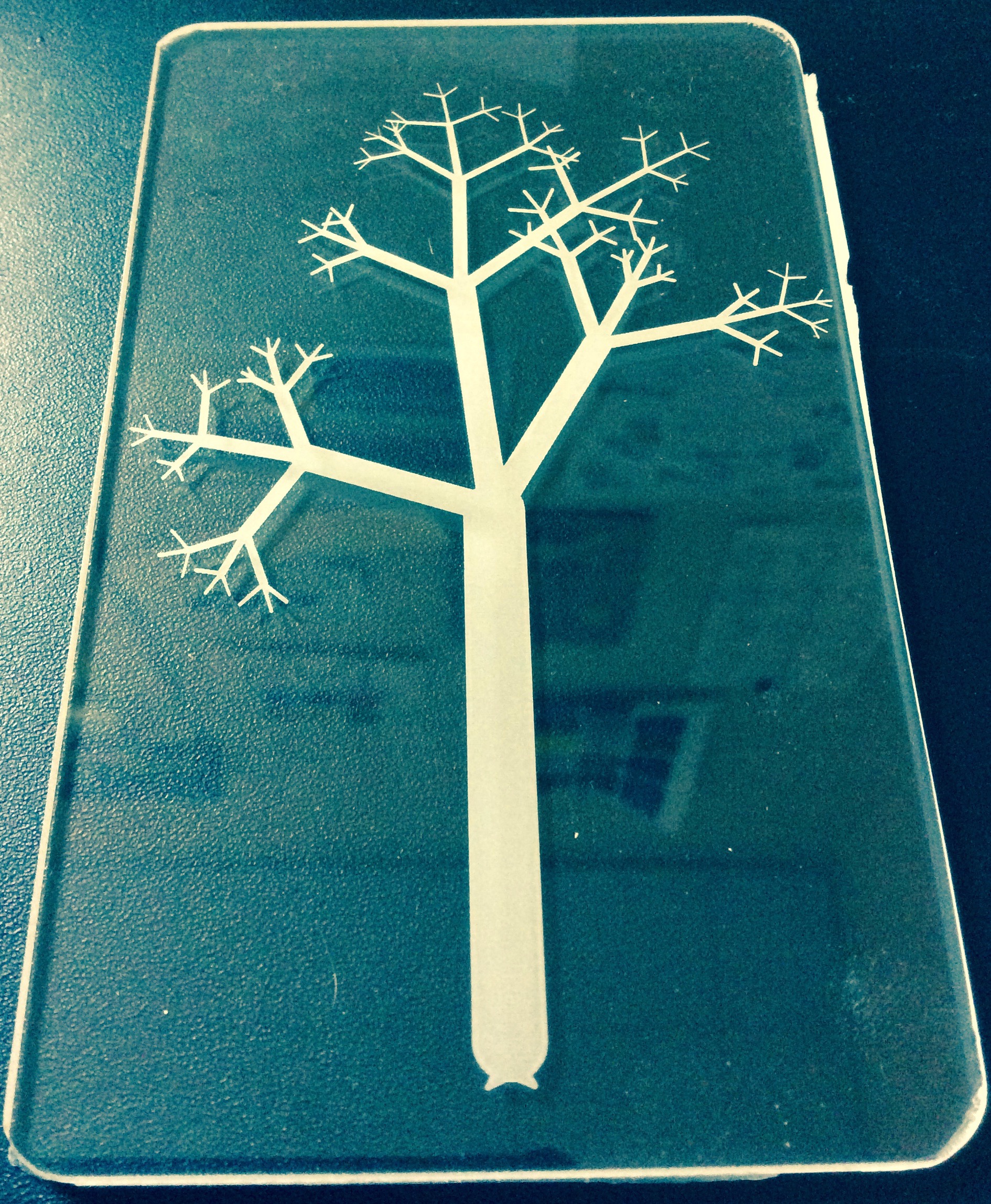
Using math and programming to make nature inspired art.

Using math and programming to make nature inspired art.

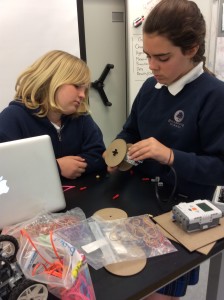
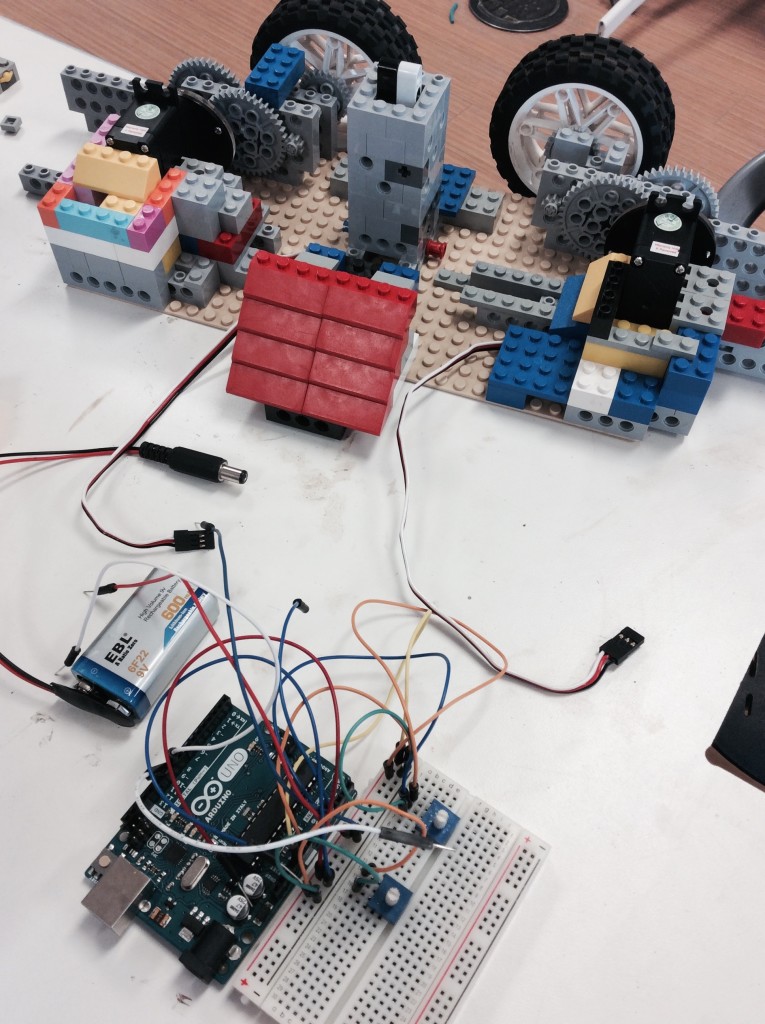
New this fall (2015), the 7th and 8th graders were offered an elective called “Robotics and Programming” taught by mechanical engineer Shea Ellerson. Ellerson built on the work done in 6th grade by introducing Hillbrook students to more powerful microprocessors such as the Arduino and Raspberry Pi. In this series of quarter long courses, students were challenged to design and build their robots from scratch using the laser cutter and available materials. Programming tools used during the programming elective included Scratch, which is a learner friendly, yet powerful tool for making digital models, animations, or games and Python.
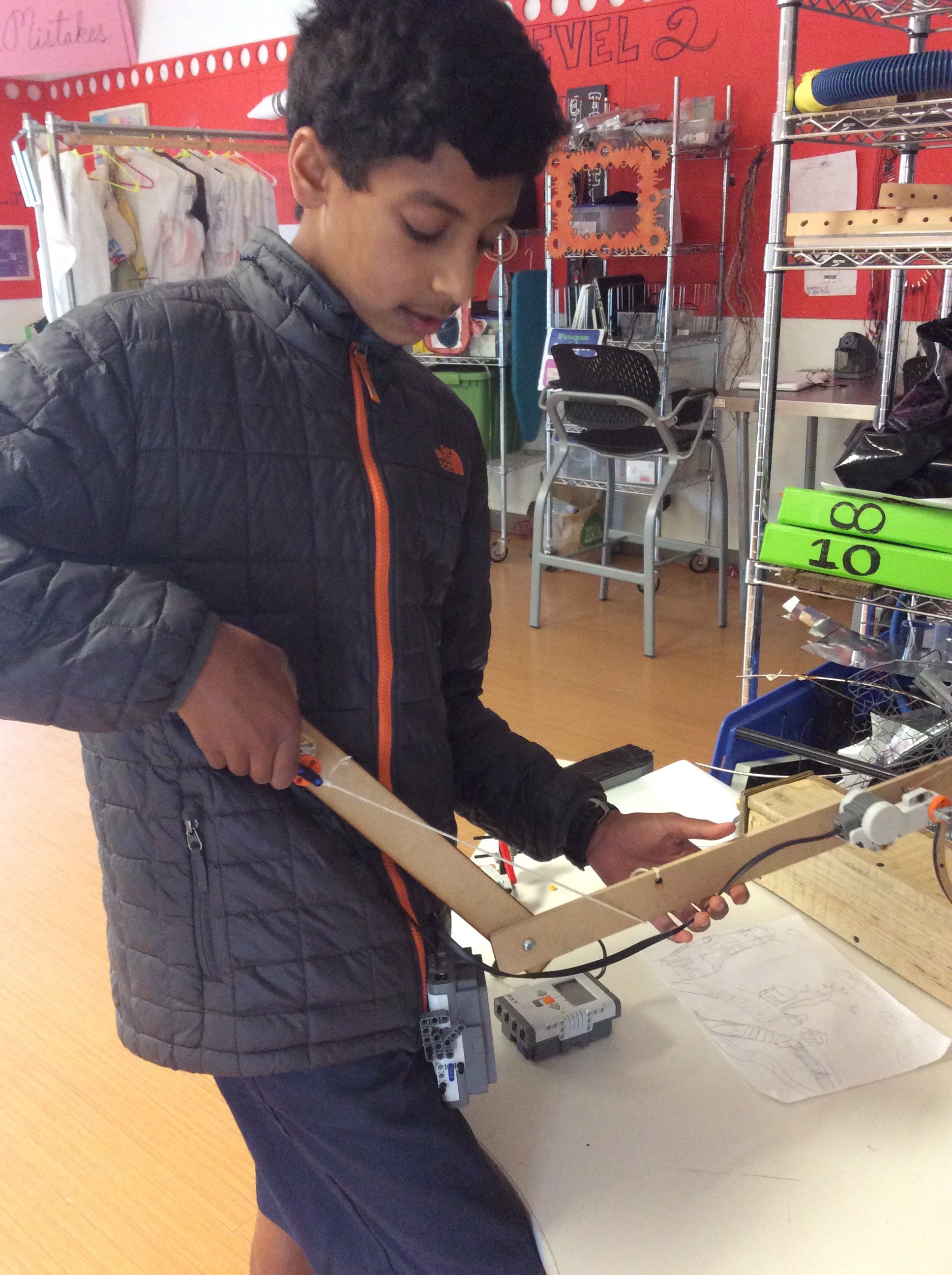
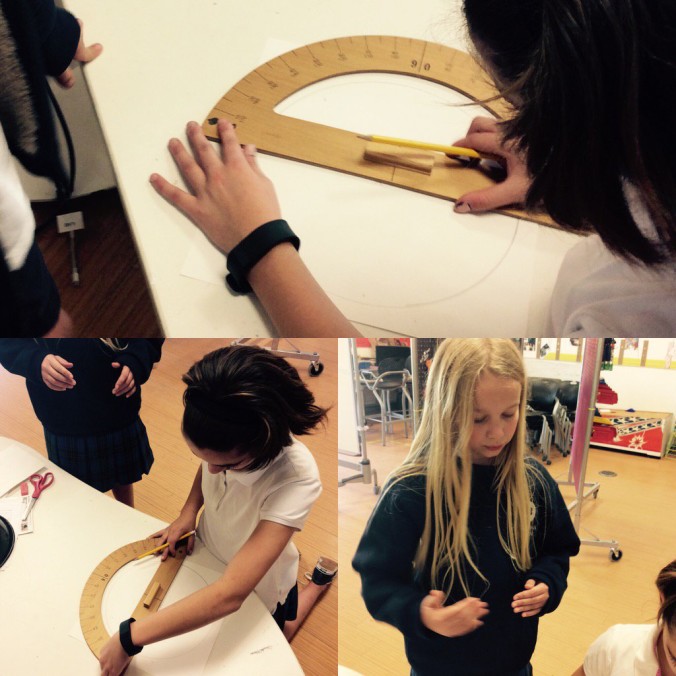
7th Grade Artificial Limb Design Project

6.12B.B (1)

Some of the most authentic assessments come after students have been introduced to concepts then asked to apply that knowledge through building working models. This project is part of an integrated physical and life sciences unit on levers in the body. In the span of a few weeks, seventh grade students are asked to design and build a device that will allow them to pick up two weights of different sizes and mass, as well as a small thin object. Brian Ravizza is a place-based science instructor for 7th and 8th graders, preferring to take students into the natural spaces on and around his campus to learn science and activism, but he also takes time to do engineering projects that would fall into the category of biomimicry. In 2011, Ravizza was looking for a form of applied assessment to compliment his biology unit on the skeletal-muscular system.

In the days leading up to this project students dissect fresh chicken wings to notice how ligaments, tendons and muscles attach and work together in a wing. As a musician, Ravizza looks at anatomy from an artistic lens, “I wanted students to gain a literacy in how things worked, but I also wanted them to have an appreciation for the sculpture of structures and how that relates to their function.” After dissecting chicken wings and discussing how levers work, Ravizza’ students engage in a two to three week bioengineering project where students design, build then put to the test an artificial limb that can manipulate objects of varying size and mass.

The first year Ravizza tried this project, students could chose to make a hand-like object or a moving arm joint. His goal was to have students make a working model with a third class lever that emulated the moving parts of a real arm. To test their designs students needed to lift a weighted object up and down without just scooping it up. Ravizza soon learned that he needed to hone his prompt for the challenge to make it more challenging. “Some students were able to solve the “problem” quickly. To meet the needs of individual students I challenged them to use a spring scale and reduce the amount of force needed to move their limb down to less than two newtons.” With each consecutive year of trying this project Ravizza has iterated on the expectations of the designed objects. Today student designs must pick up three objects, a soup can with a 200 gram weight inside, the 200 gram weight alone, and a short skinny straw.

In a few years the project evolved in several ways. Now that students are more familiar with the tools of the school’s makerspace, some projects incorporate laser cut pieces, 3D-printed pieces and in some cases, simple programming tools to move the limbs. Students have also been able to see how their work applies to the real world through a series of unique opportunities. The first opportunity came when a real artificial limb designer visited the school to discuss her work. After her talk she met with the young designers and gave feedback to final designs. The second opportunity came through a former faculty member whose daughter had been born with missing digits in her left hand. The faculty’s daughter was a kindergartener who dreamed of being able to use the monkey bars just like her peers. Ravizza’s students found themselves working with an organization called Enabling the Future (http://enablingthefuture.org/) that helps people 3D-print hands for children. Ravizza’s students were able to use the organization’s online and open source tools to help one of their own community members. When two seventh students realized the designs available online would not help the girl safely hang from the monkey bars they spent the rest of their project time designing an apparatus that could. “It wasn’t exactly true to the project parameters,” says Ravizza, “but it was a real need and it was real life. The girls designing the new solution were super motivated.”

Assessment for this project came in the form of careful documentation of the design process. Each day students kept individual notebooks recording how their design faired testing, what materials they used and why. Notebooks also kept detailed sketches with true measurements, offering another view into student understanding. Other forms of assessment came when students shared their work in front of the class in a final and dramatic test of their designs, along with a verbal explanation of how their design modeled a real arm or why it did not.

The HERstory Museum Project

Hillbrook’s 5th grade, the class of 2019, has embarked on this year’s spring hard problem, a semester long deep project in science that addresses rigorous research practices, as well as a challenging engineering and design prompt. What makes the spring hard problem so hard? In the spring students are asked to apply everything they have learned in Problem-based science during our Materials, Patterns, Structures and Systems units. Now we are in our deep dive into our Problems unit. Problems are defined as needs in our environment and often require designing and engineering innovative solutions. Problems are rated on a level of 1-2-3-4, where level 3 and 4 problems are real world problems. Level 3 problems are hard but can usually be solved by a learner’s local network of peers, teachers, parents, grandparents and other available mentors.

This year is the hardest problem assigned yet, as the class of 2019 will also be investigating a Level 3 and a Level 4 problem. Level 4 problems affect people globally. This year’s level 3 or local problem is to finish the construction of the addition to the Village of Friendly Relations began by the female builders of the class of 2015. Our Level 4 problem is a historical and global problem, women’s rights and educational equity. This year’s project has students in search of a story about a heroine to serve as inspiration for a 10 foot by 12 foot interactive history museum inside the uncompleted structure in the heart of campus. We are calling this year’s project the Hillbrook HERstory Museum.

To structure a design and engineering challenge of this magnitude the class of 2019 has been given the following rules to follow:

Phase One: Research and Inspiration

Rule One – Work with an adult mentor on campus to research women in history who had a great lesson to teach and form a few essential questions.

Rule Two –  Chose one person who links to Hillbrooks’ history or Hillbrook’s Core Values (Be Kind, Take Risks, Be Your Best, Be Curious) and answer your essential questions to craft a HERstory that needs to be told.

Phase Two: Design, Build and Test

Rule Three – Use your HERstory to inform the design of an interactive museum that spans a timeline from 1935-2015, in honor of the school’s 80th anniversary.

Rule Four – The museum must apply the mechanical arts and renewable energy sources.

Students have arranged themselves into eight teams of 4-5 collaborators to take on one of the eight decades of the school’s history. Teams will have all spring semester to complete their research, design and building. To share the journey of this project each team has created a website with a blog. To check out our first blog posts, get inspired by real heroines and student historians, please see the links below. You can also come see their work on May 20th – 22nd in San Mateo at the 2016 Bay Area Maker Faire.

5A Teams

“The Guardians” – Aydin, Ceanes, Mira, Jackie

Website: https://sites.google.com/a/hillbrook.org/the-guardians/

“The Tiger Masters” – Tristan, Landon, Ruby, Marissa

Website: https://sites.google.com/a/hillbrook.org/tiger-masters/

“The Survivors” – Freya, Tess, Michael, Alex

Website: https://sites.google.com/a/hillbrook.org/the-survivors/

“The Fireballs” – Zoe, Tyler, Logan, Joanna, Kyle

Website: https://sites.google.com/a/hillbrook.org/the-fire-balls/


5B Teams

“Rainbow Atoms” – Evan, Kate, Elise, Miles

Website: https://sites.google.com/a/hillbrook.org/rainbow-atoms/

“Kawaii Creepers” – Elsie, Robert, Derek, Erika

Website: https://sites.google.com/a/hillbrook.org/kawaii-creepers/

“Super Scientists” – Jackson, Karly, Emma, Ian

Website: https://sites.google.com/a/hillbrook.org/super-scientists/

“Jr.Sl inc.” – Sam, Josh, Lucas, Ryan

Website: https://sites.google.com/a/hillbrook.org/jr-sl/home


The Class of 2018 goes to Maker Faire

In fifteen days, the class of 2018 will showcase their work at Maker Faire, deemed the “greatest show and tell on Earth,” and for good reason. Showcasing work publicly is a healthy form of external reward, allowing others to learn from and get inspired by your hard work. Hillbrook will be celebrating its third year hosting a booth to showcase our student’s inventions, and year after year our students stand out for their confidence, creativity and “can-do” mindset.

Practicing problem-based-learning in the iLab for three years, I have designed and researched innovative curriculum to study the benefits of Maker Programs in a PK-8 educational setting. As part of a cohort of researchers and practitioners at Stanford to discuss best practice and relevant research in Maker Education, this collaboration has taught me, and many others looking to our program for inspiration and direction, the real value of applying the design process in education.

Using the design process to help others, as a platform to engage students in science content or acting out the steps of the scientific process, is a classically human form of learning, and it works. In a recent New York Times post, using design to solve problems was credited for getting more girls to enroll in engineering course work. The best predictor of STEM career choice is whether they self-report by the end of middle school, as seeing themselves as scientists when they “grow up” (Maltese & Tai, 2011). Students who tinker, question and invent, are more likely to develop positive identities that encourage a life-long love of science, math and the creative process.

From Hillbrook’s smallest makers in Kindergarten, to Hillbrook’s graduating class of 2015, examples of living the design process and sharing work abound, and inspire.

For instance, in Problem based Science, 5th graders spend 2/3rds of the year discovering how to apply skills and content towards the creation of a complex artifact that fills a need on campus. With the help of 10 Hillbrook faculty and staff members, volunteers Lucas Wilson (mechanical engineer), and Chris McKenzie (parent to Madelynne ‘18), along with the promise of sharing work at this year’s Maker Faire, the class of 2018 has been deeply immersed in the design process.

Taking time for the design process encourages academic risk taking and collaboration. Deep projects also support literacy in science, math, research and writing. Mathematical literacy is applied when calculating ratios, geometric dimensions and scale. Students practice self-directed literacy and executive functioning when crafting a professional email to their adult collaborator asking to schedule a time to test their design. Knowing when your design is ready for testing and feedback without the teacher telling you…that is living the design process! Questioned how a trebuchet was filling a need, 5th grader Eli and his team spent hours crafting a persuasive essay in defense of the medieval weapon of siege. ”Knowledge of how to use a dangerous tool makes it less dangerous. If you know how to use something correctly, there is less room for error. The trebuchet will teach people to be more careful,” argues Eli, unaware of how cool technologies and learning about ballistics can support social emotional learning in boys. Understanding your ideas well enough to “sell” them to others? That is living the design process.

Members of the class of 2015 have also lived the design process. From an idea first formed in 2013, to seeing boxes of “10 Penny Nails” resting against an asymmetrical roofline, the building of the Hillbrook History House has been a year-long showcase of work in the heart of our campus.

Perhaps the greatest lesson that I have learned from Maker Education is that hands on learning, and real problem solving can bring out the creative genius in students. It has been especially successful for students with learning differences, such as 5th grader Morgan, who began the year with some trepidation having been diagnosed with dyslexia. Free of the pressures of dysgraphia or spelling, she used learner friendly technologies (such as Explain Everything and iMovie) to tell her learning story, and what a story it has been. In short order, Morgan learned to 3-D print, laser cut, make scale models, code in Scratch, design interaction devices for video games that teach math to younger students, and designed a board game that promotes creativity and teamwork. Solving problems in your community, working at your full potential, and making something that works…that is living the design process.

Once making the shift to a learning facilitator, I was able to expand my own understanding of how students learn and share that knowledge globally via webinars, local Maker Educator meetups, conferences and of course digital professional learning networks, such as Twitter. A story I proudly shared at this year’s CAIS regional conference came from earlier this year. A projector was broken and I was about to email for tech-help, my advisee Raya reminded me to practice a “maker mindset” when she exclaimed, “Ms. Flores, this is the ilab; we have tools. We can fix it!” and then she proceeded to do so. Access to real tools, knowing when to apply them spontaneously…that is living the design process.

Maker Education reminds us that real work takes time and trust in learners. Trust is formed when you keep an optimistic view of children, their desire to do good, and their ability to self-direct when engaged by relevant content. If you’re interested in seeing how making fosters a sense of agency, that can lead to making the world a better place, please come to Maker Faire, May 16th and 17th, and hear it from our inventors first hand.
Images of Spring Hard Problem Class of 2018

Works Cited

  1. Maltese, Adam V., and Robert H. Tai. “Pipeline Persistence: Examining the Association of Educational Experiences with Earned Degrees in STEM among U.S. Students.” Science Education 95.5 (2011): 877-907.
Older posts