The Awesome World of Making @ Hillbrook

Stories of Making and Constructionist Learning

Category: Middle School Makers (5-8th) (page 2 of 3)

Witness the awesomeness of what kids can do when given the opportunity to direct their own learning in science, math and engineering. In 2012, we redesigned the 5th and 6th grade science curriculum to be taught in a maker space full time. Classes are now process, rather than content driven, with an emphasis on analog and digital making, tinkering and fixing. Using problems as prompts, students are allowed to work on solutions for long periods of time using the tools of digital and analog making. Problem based science is taught to 5th grades all year in science class. In the iLab, the 5th graders are presented with Prompts (basic rules or criteria for pass/fail) for the three of four possible units of study. Unit One is Materials (material science), Unit 2 is Patterns (asking questions, measurement, data visualization and logic), Unit Three is Structures (engineering and design) and Unit Four is Systems (interdisciplinary science). Problem based Science can be extended into all of middle school in short term projects as well as in our iLab hosted electives in seventh and eight grade.

It Takes a Village to Build a Village; The Revival of Hillbrook’s Village of Friendly Relations Project: version 2015

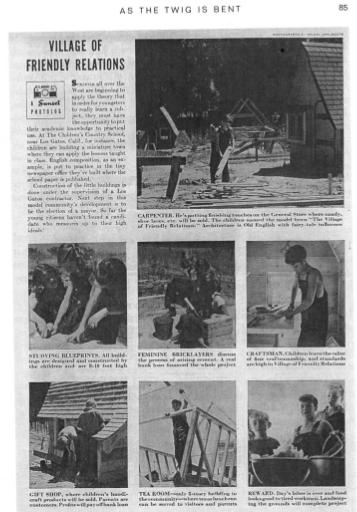
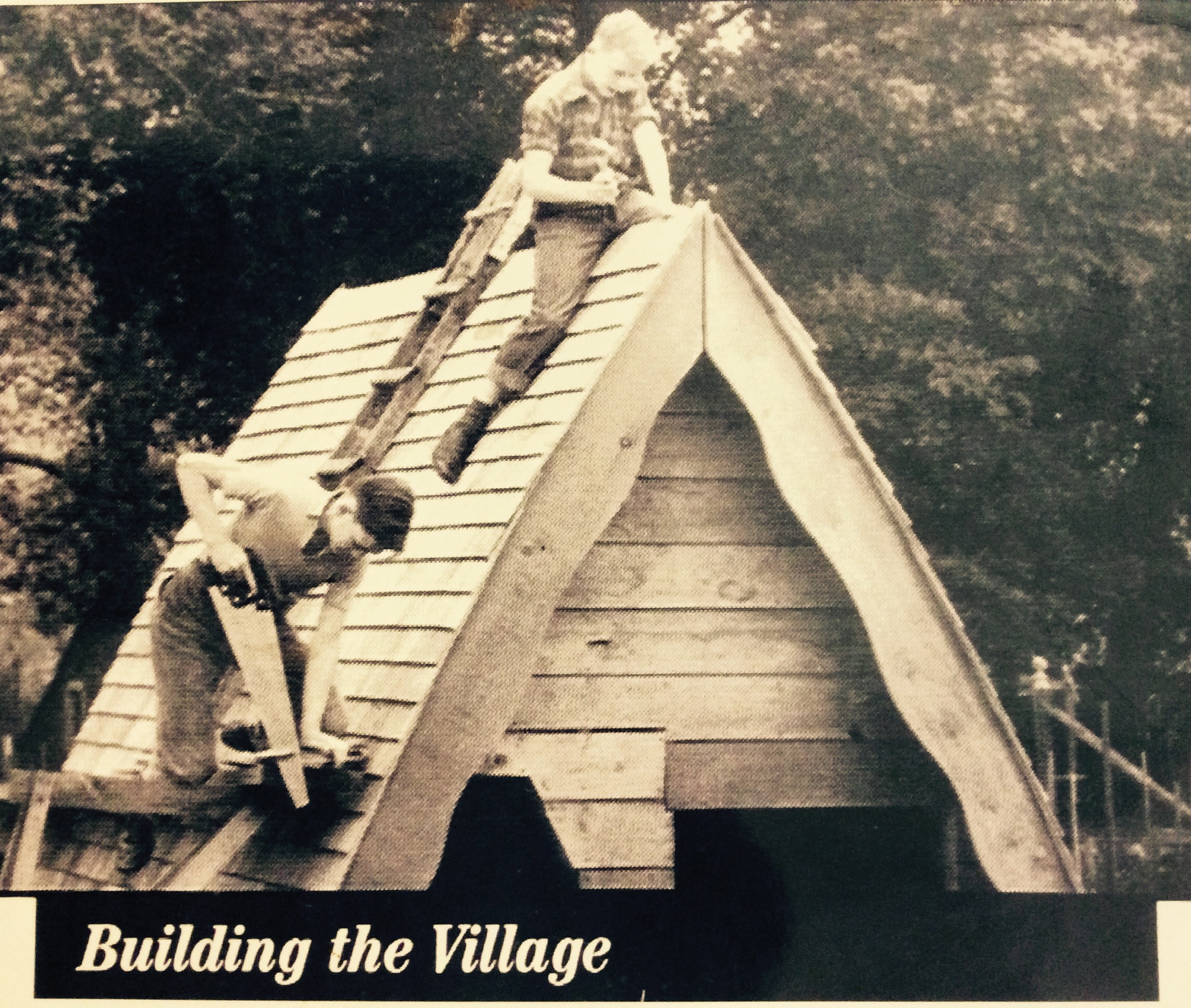
Feature in Sunset Magazine 1939.

Feature in Sunset Magazine 1939.

In the September 1939 Issue of Sunset Magazine, Hillbrook’s Village of Friendly Relations was featured as a testament to the innovative and human-centered approach to education, then head of school Mary Orem was passionate about.  According to detailed documents stating the purpose of the project, Ms. Orem designed a curriculum for children that would;

1) Allow children not normally celebrated in a traditional school setting to be leaders, 2) Empower students with real world problem solving and building skills,  and 3) Encourage children to practice peaceful resolution to conflict in a mistake friendly environment. The Village was not just a cluster of play houses, it was a scale model society, with real world problems for children to learn from. In a sense, it was also Hillbrook’s first attempt at redesigning the classroom.
Real Tools + Real Materials + Real Problems = Real Learning

Real Tools + Real Materials + Real Problems = Real Learning

Sadly, the village project ended when funding for the buildings was supplanted with needs to keep the school running during war time. World War II was a time of great nationalism, do it yourself mentalities and a desire to reduce, reuse and repair.  When the war ended, priorities shifted again. In the 1950’s and 60’s American culture moved away from a DIY mindset that celebrated the role of women in the workforce, to one of hard gender roles and compulsive consumerism. Perhaps more insidious a shift, was the competition centered approach to education that defined the Space Race.  As a result, in the past five decades, less focus has been on real world problems and integrating subjects for a more holistic approach to learning. More emphasis has been placed on teaching the subjects of math, writing, science and reading in artificial silos, with an increased emphasis on ranking and high stakes test taking. School became less about empowerment through learning, and more about competition for coveted college and high school admissions placement.

Fast forward to March, Friday the 13th 2015, and you may have read the Friday letter by Mark Silver declaring how the Village of Friendly Relations was the original “Makers Movement,” a movement that was paralleled by the Craftsman and Progressive Education movements of the early parts of the last century.  A re-examination of how we teach and learn is at the forefront of educational discussions, as Mr. Silver noted in that letter. In the 1930’s, Hillbrook, then The Children’s Country School, was at the forefront of innovative curriculum that has been proven to be better for learning and for kids. Today, we see similar work continuing in much of what we do intentionally at Hillbrook.
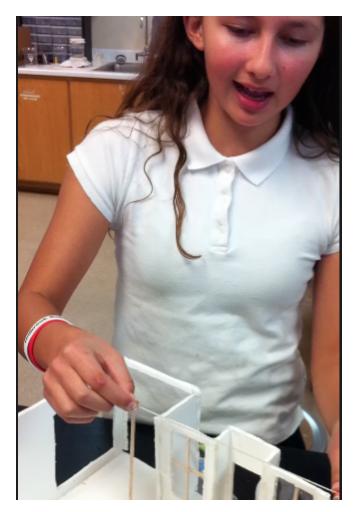
Gabriella Underwood, explains how she solved the hard roof problem for the Tiny Green House Project, a project first launched in 2012 as part of the science department redesign to include science in the context of STEAM, architecture, engineering and mathematical arts. Gabby formally joined the team as a member of the Y.E.S. elective of 2014.

Gabriella U., explains how she solved the hard roof problem for the Tiny Green House Project, a project first launched in 2012 as part of the science department redesign to include science in the context of STEAM, architecture, engineering and mathematical arts. Gabby formally joined the team as a member of the Y.E.S. elective of 2014.

The topic of the Village houses has come up a lot in the past three years, thanks to the work of resident historian Mr. Paul DiMarco and his book and documentary entitled, “As the Twig is Bent: The Story of the Children’s Country School”. Inspired by the video documentary, which was shown to students in the Spring of 2013, five 6th graders approached their then science and engineering teacher to ask if they too could build a house in the Village. “Why not?” I wondered, and for the past two years we have been co-learning as a school, and as a team, what it takes to build a Village house.
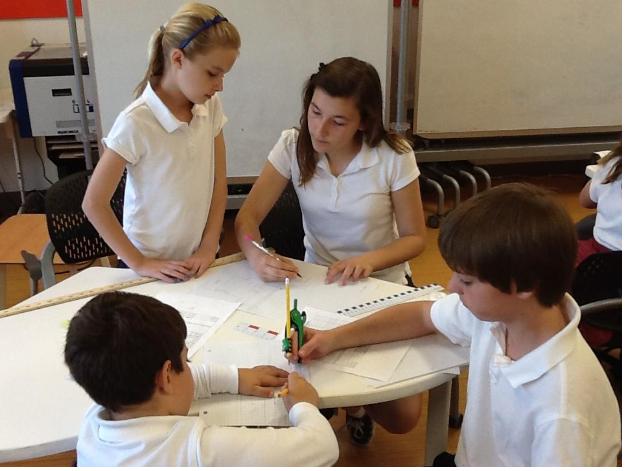
Katherine Bonelli (2015) mentoring Jaden Steinbach (2018) on making floor plans in 2013 after completing her class project Tiny Green Houses. Katherine joined the HHH team in the spring of 2014 as team documentarist.

Katherine B. (2015) mentoring Jaden S. (2018) on making floor plans in 2013 after completing her class project Tiny Green Houses. Katherine joined the HHH team in the spring of 2014 as team documentarist.

Class of 2015 members, Emily S., Emma S., Lilah P., Sam B., and Lora K., having spent time consulting with the school’s long time contractor Kim Midstokke, felt armed with a list of action items, such as drawings and a budget, to present to current head of school Mark Silver. Their proposal was accepted, and now the hard work of learning how to build a house began. We had taken on a very hard problem indeed. We needed to enlist a team of experts to get this project off the ground.

During their 7th grade year, the team still consisted of only the original five students. We met every Monday at lunch during the spring semester with our mentor architect, Stephan Sun,  now attending Harvard’s Graduate School of Design. At the end of their 7th grade year, the team had real architectural drawings based on their ideas and designs for the new building, the title of which was now the Hillbrook History House.
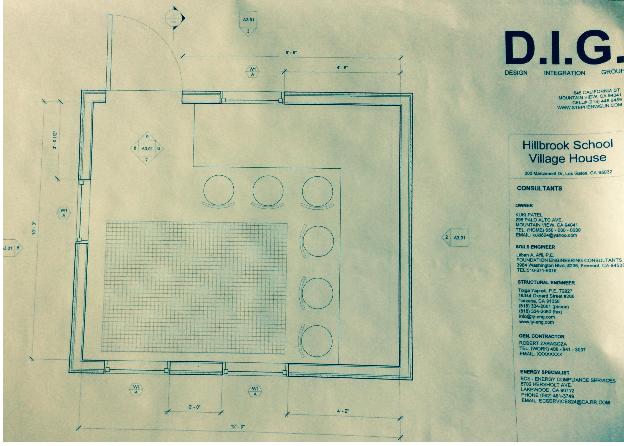
Floor plan drawings made with mentor architect Stephan Sun.

Floor plan drawings made with mentor architect Stephan Sun.

Armed with the knowledge of how an architect takes ideas and makes them into drawings our next step and the hardest work of all was still to come. How do you take drawings and actually build a house? Enter building mentor Tom Jameson of the Hillbrook Maintenance crew and parent mentor Sarah Kately, project management guru and indispensable project champion to the HHH team.
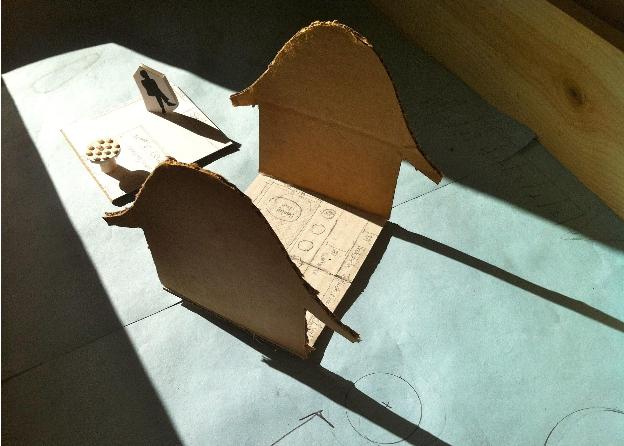
Prototype making lesson in the iLab with mentor architect Stephan Sun. Laser cut cardboard for rapid prototyping to define the form of the new village house.

Prototype making lesson in the iLab with mentor architect Stephan Sun. Laser cut cardboard for rapid prototyping to define the form of the new village house.

In the fall of 2014, the HHH team grew again. Under the title of Y.E.S. (young engineering scientists), a first time elective for 8th graders was offered to solve this problem of how to build a house. This first quarter elective was a prototype capstone project, an initiative of Hillbrook’s growing Maker Education program, to see what students could accomplish with four hours a rotation dedicated to a passion based project, designed by kids for kids.
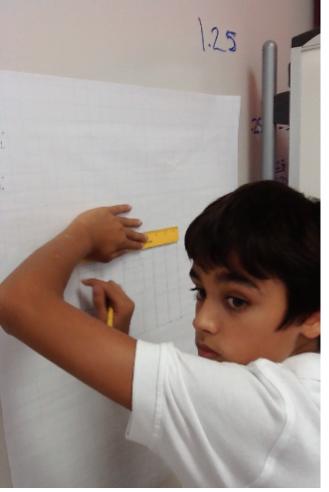
Nevin Richards joins the HHH team in the Y.E.S. elective as team mathematician. Nevin kept record of how math was an integral part of building homes.

Nevin R. joins the HHH team in the Y.E.S. elective as team mathematician. Nevin kept record of how math is an integral part of building.

This elective was inadvertently designed to mimic the holistic, student-centered approach of the original Village Project designed by Mary Orem. The HHH team dutifully documented their learning in areas of math (geometry, budgeting, blueprint making, and scale), literacy (blog to tell the story), technology (using digital fabrication for prototyping scale models), art (architecture lessons), historical sciences (research, analysis, primary document reading), science (material science, physics), and citizenship (sustainability, resource management, public speaking, etc.). The Y.E.S. elective also opened up this rare and amazing opportunity to more members of the soon to be graduating class of 2015. The team now consisted of 8th graders Lora K., Sam B., Liliah P., Emma S., Isabel P., Meghan M., Katherine B., Chaaya P., Gabby U., Nevin R., Seamus S., and Caryus P.
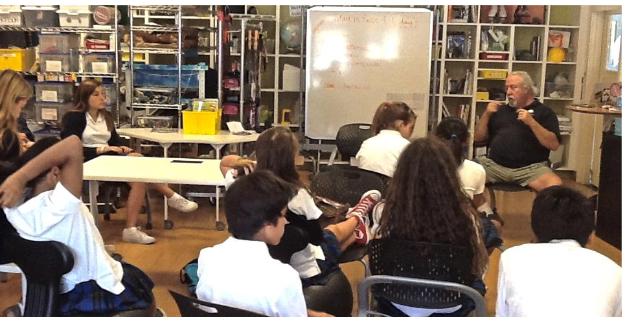
Alan mentors the team around what would make the best foundation for the house and its building site.

Alan mentors the team around what would make the best foundation for the house and its building site.

Once the fall elective ended, the team continued to shift and grow. Having constructed four walls and a floor, their fall term goal, the team faced their next hard problem; building a roof with an asymmetrical pitch design.
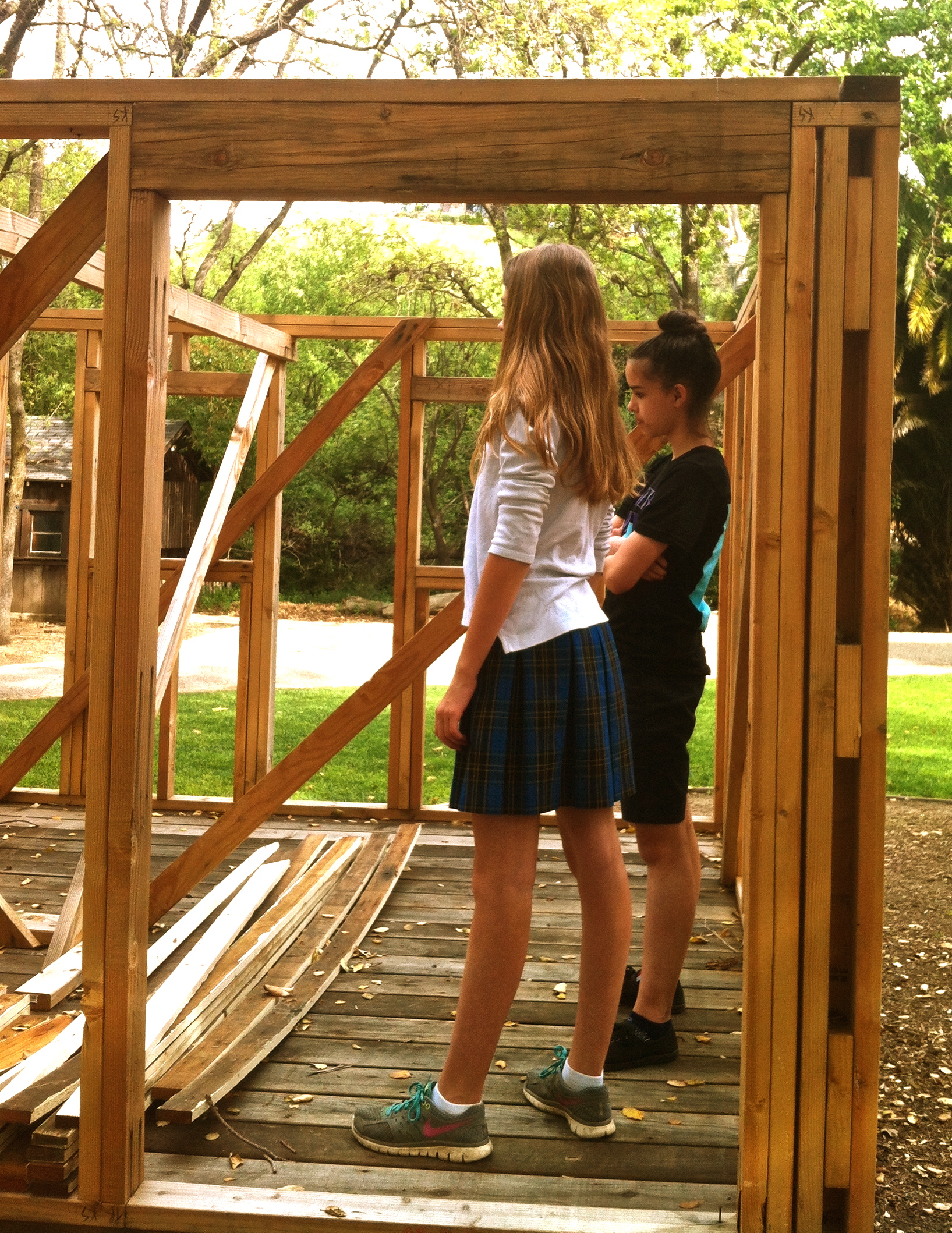
Aspiring architect for the HHH team, Lora Kateley shows off her handy work to classmate Nicole Grant. They stand within the walls of the first quarter elective construction.

Aspiring architect for the HHH team, Lora K. shows off her handy work to classmate Nicole G.. They stand within the walls of the first quarter elective construction.

The “roof problem” was thrown around for a few weeks until Tom Jameson and Ken Hay volunteered to help solve this problem by volunteering their Monday afternoons to allow the HHH team to build. Adult mentors now consisted of builders Ken Hay, Alan Bahnsen and Tom Jameson, project managers Sarah Kateley and Mrs. Pac, as well as documentarists and story tellers Paul DiMarco, Debbie Dembecki, and Ms. Flores, to name just a few.
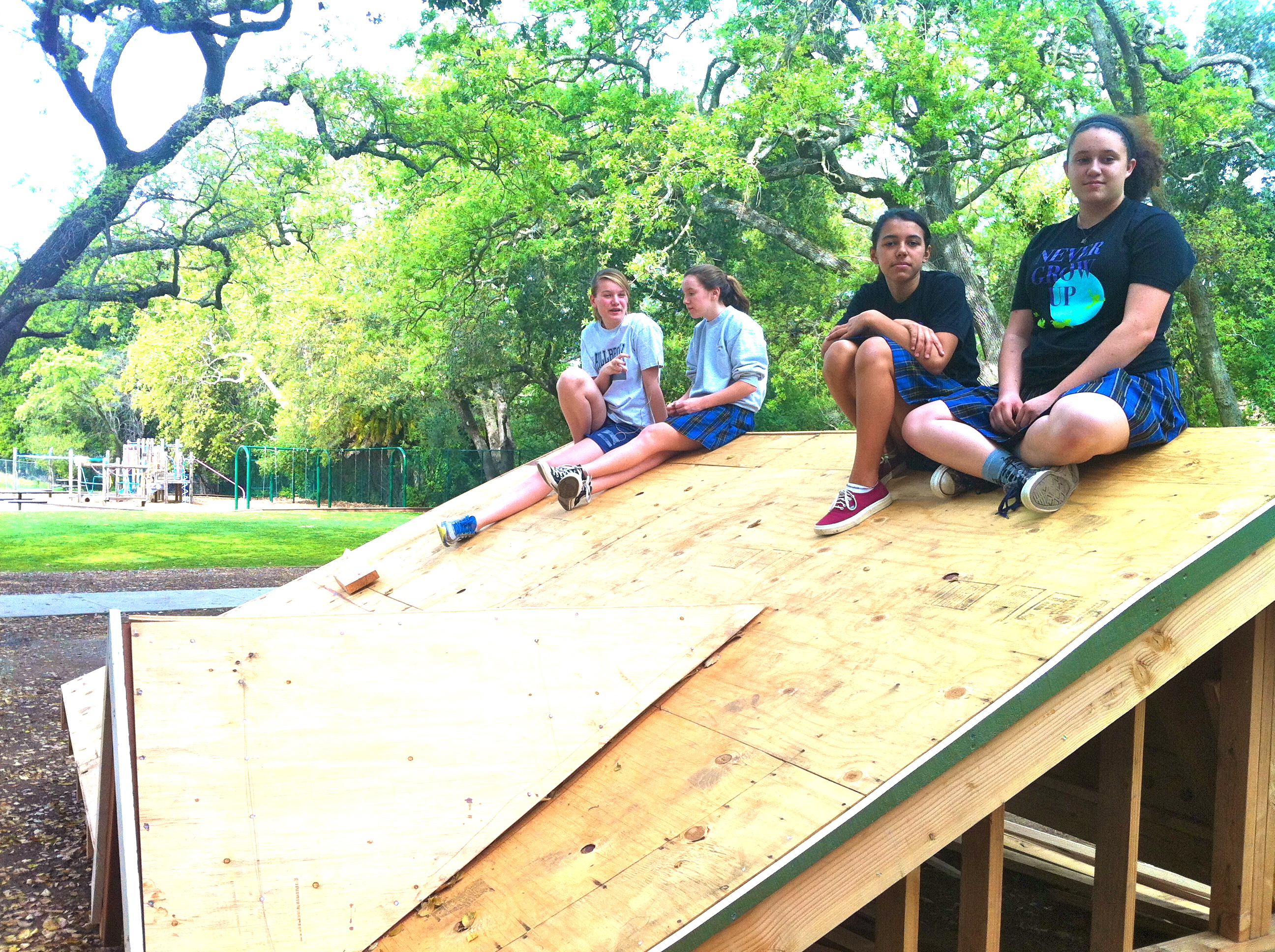
Reminiscent of the original builders enjoying the structural integrity of their hard work, core team members Lilah Penner Brown, Sam Borbas, Emma Skeet and Isabel Perez atop the "roof problem."

Reminiscent of the original builders enjoying the structural integrity of their hard work, core team members Lilah P., Sam B., Emma S. and Isabel P. atop the “roof problem.”

As it turns out, it takes a village to build a village. During the Spring quarter electives, the HHH team members will continue to work on the construction of the house for 4 hours a rotation with mentor Ken Hay and Tom Jameson. As of now, no one knows what “finished” will look like, but everyone agrees that rediscovering our history through this History House has been a rich learning experience for all. Even the kindergarten study group focusing on woodworking got a chance to help add roof shingles to the new house as part of their curriculum.
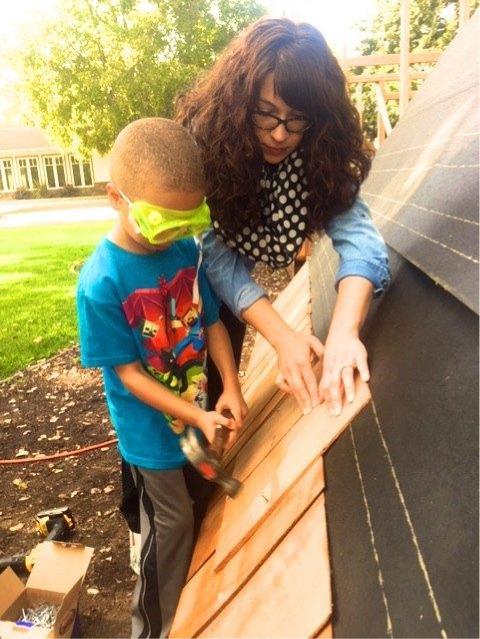
Ms. Collins, Kindergarden teacher and co-learner Victor Torres, are members of the Wood Working study group. Study groups let students chose topics they are passionate about, while learning in a social and constructivist environment.

Megan Collins, Kindergarden teacher and co-learner Victor T., are members of the Wood Working study group. Study groups let students chose topics they are passionate about, while learning in a social and constructivist environment.

Perhaps the most important message learned from this project, is that working together is how our community can solve hard problems. Stay tuned, as the construction of a tiny house revives the kind of educational experiences we strive for at Hillbrook.


Design Detectives for the Common Good

It is second semester in Problem based Science and the class of 2018 is well into their “Spring hard problem.” The spring hard problem marks the end of our patterns unit and the beginning of our study of structures and systems. During our study of structures, students get a chance to use their understanding of materials, measurement and patterns to make blueprints for designs and to conduct scientific testing of those designs. If those structures involve moving parts or varying materials or embedded electronics, they are also learning about the relatedness of things that make up a system.


Applied math comes readily in class with measurement, re-measurement, simple geometry problems and budgeting.

Applied math comes readily in class with measurement, re-measurement, simple geometry problems and budgeting.

What makes a problem a hard problem?

Hard problems require time (months), collaboration, creativity, grit and learning new skills to pass a challenge. The true sign of a good hard problem is when the adults do not have all the answers for students, rather the students get to take charge using their own imagination and ambition to reach a goal set by their team.

This year’s title? Design Detectives for the Common Good! This year’s spring hard problem was an adaptation of a 6th grade level design thinking challenge, with a green twist. To learn about structures and systems, as well as collaboration between and within teams, the class of 2018’s spring hard problem consisted of the following rules:


Rule No. 1    

Collaborate with an adult on the Hillbrook campus to find a need

Rule No. 2

Brainstorm with your team to design a solution to the need you have found

Rule No. 3

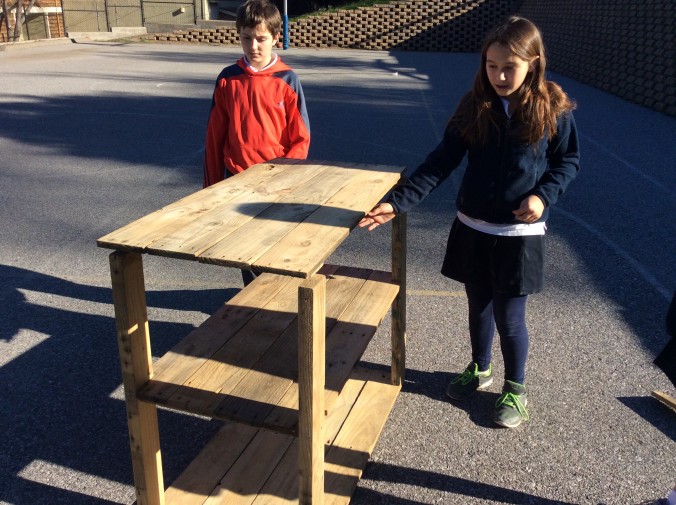
Your solution must be made with upcycled materials (This year we had a lot of pallets from the new furniture deliveries and a box of e-waste delivered to the iLab by a parent).

Rule No. 4

Your solution must be beautiful or create connections at Hillbrook


This year’s gracious collaborators are Megan Collins, Kindergarten teacher, Ronnette Chandler, Hillbrook receptionist, Christina Pak, middle school head, Susanna Long 3rd grade homeroom teacher, Emily Hendricks, technology genius, Lara Blom, lower school science teacher, Ilsa Dohman, upper school science teacher, Dhimant Patel, aftercare staff and maintenance crew, Robert Sears, upper school math teacher, Jenn Bogart, middle school english teacher and Ms. Flores 5th grade science instructor.

Using Empathy to find the needs of others

To discover a need on the Hillbrook campus, the class of 2018 interviewed, observed and surveyed their collaborators. They took notes, captured images of areas on campus of interest and presented their ideas to the entire class for feedback. Most teams have settled on just one need from their research, have built prototypes of their solutions and are now ready to begin making something real. Screen Shot 2015-02-24 at 2.12.33 PM


Measuring Growth in Problem based Science

All problems are graded on a Pass/Fail system with an opportunity for passing with honors or failing with honors. There are no paper tests in problem based science. We use the process of scientific testing, documentation of work (using Google Docs collaboratively to record progress), building and evaluating prototypes, and peer and self-reflection to focus on the formative assessment of work. Teams get points for sharing their work during peer critique sessions when they get vital feedback about how to improve their designs and share arguments for their use of materials or a design. Summative assessment comes in May when the spring hard problems are shared with thousands of curious minds at the Bay Area Maker Faire and all students make an argument for their final grade, using evidence and reasoning. Stay tuned as the class of 2018 Design Detectives for the Common Good make real artifacts that help make Hillbrook more beautiful and more connected.

The Hillbrook History House Begins!!

Hillbrook History House Project Progress Report #1:

Hello everyone, this is Katherine and Meghan with the first progress report. Our goal is to send out one progress report at the end of every week. The progress will include pictures of the project’s status. In our first nine classes we have established 6 different roles and this will explain each one.

Chaaya has assumed a very creative role and is constructing a documentary about the process of this long term project that will span two electives, perhaps an after school course and a few weekends to complete. The movie will also show our entire process step by step and explain each person’s roles throughout the project.

Isabel, Emma, Gaby and Lora, have been building a practice wall. This job is called framing or carpentry. The framing team finished the practice wall in only 8 classes. When we start to build the real walls, each of the original framers will assume responsibility for one wall of the house. She will then mentor and build that wall with the help of two other members each from the group.

Based off of scale drawings (see above) that taught the class the key terms of framing, Caryus finished the materials list that will need approval from our expert mentor carpenter, Tom Jameson. He will continue to work on the materials list for the floor and walls and future material needs, such siding and windows and doors.

During the past week Seamus has been working on a to scale, miniature, prototype of the exterior and interior of the house. Seamus is using CAD software and the laser cutter for this task. The interior will have a blueprint of what our plan is for the furniture once the house is built. Three dimensional buildouts of the interior features, such as counters, shelves and chairs will also be added later. The prototype will serve as a model to give others an idea of what the final house will look like once its complete.

Nevin has been working on a presentation explaining how applied geometry makes the building of the History House possible. Using the Pythagorean Theorem people can measure angles. It is essential that all the angles be spot on or else the walls will be unstable. Nevin will continue to work on this project to explain how geometry is used in many aspects of the house.

Lilah and Samantha have been working on the house’s foundation. The foundation consists of  four cement blocks with four 4 x 6 inch wooden beams on top of them. Lilah and Sam first needed to square the four main beams of the foundation. This was a great opportunity to practice the use of the pythagorean theorem. The next step was to level the whole 10 x 12 foot frame and nail the foundation together.

Next, the HHH team will be building the floor for the new structure and putting together the real walls for the house using their new framing skills.  Stay tuned!

Maker Faire, awesome authentic assessment for student work

Authentic Assessment:

Maker Faire and the Public Showcase of Work

Happy customers played the game “Exploring the Stars” by 5B endlessly all weekend.
Here a boy smiles as his friend waits impatiently by to get his turn.  


Less than 24 hours ago, the Hillbrook school spent the weekend at the Bay Area Maker Faire where hundreds of thousands of curious onlookers got to see the kind of work Hillbrook’s students are making in the school’s MakeSpace for applied technology, engineering, art, math and science (t.e.a.m.s.). Hours of energy, designing, testing and prototyping paid off, as students shared their work with the world and got to see the looks of amazement and joy as their games were on display.

Student at the Maker Faire making basic blueprint posters to represent
their teams individual project efforts and tinkering to get their machines
up and running.
 

While both machines arrived at the faire grounds Friday unfinished, students spent much of Saturday getting one machine up and playable. Once online, the game miraculously lasted all weekend under the heavy user testing environment of the Maker Faire with only one small repair issue by Sunday afternoon, a loose flipper. This testament of engineering by the class of 2017 is evidence that with enough time and hope, even kids can make something real, like a working pinball machine.

Hillbrook’s booth was in the Young Makers Expo Hall, along with other Bay Area schools such as the Menlo School, Nueva, Castilleja, Lighthouse Community  Charter, Athenian and East Bay School for Boys. Maker Faire not only gives students a place to share their work with like-minded inventors and scientists, it gives students a chance to practice their public speaking.  Above, 5th grader Haley explains the class project to interested players.  Historically (Hillbrook attended first in 2013) Maker Faire has been a right of passage for 5th graders but 6th graders have also used the venue for testing and showing the products they designed in problem based science level 6.

Below 6th grade student Claire shares her tactile memory game called “TextureTiles” with interested gamers at the Faire. She has been working on this game all semester as part of her requirement to research a problem and design a solution that addresses that problem. She chose the lack of educational games for the blind as her topic. Claire went above and beyond the yearly goal of doing two forms of active research for her product design by doing two additional forms of active research at Maker Faire. She attended the event on Saturday, felt she had some improvement to do on her experiment design and came back for a second round of testing on Sunday, this time with a bigger and more impressive set-up.

6th Grader Claire does product testing on site at Maker Faire on Saturday.

Maker Faire is an exciting platform for students to share and talk about their ideas and inventions. Maker Faire opens the doors for students into a community where they are accepted as smart, creative and cool. With adult help, students can also fill out the project application themselves as students from Lighthouse Community Charter School do.  Taking ownership over the process of showing work to the public is an extremely valuable skill for young makers to have and one we will create more space for in preparation for Maker Faire 2015!

6th Grader Claire continues product testing on site at Maker Faire with help from B.B. on Sunday, now with her poster board.
Older posts Newer posts