At the Hillbrook school, art has been a vital part of our curriculum for decades. Now we have the collaborating team made up of Jenny Jones, 3rd and 4th grade science teacher, and Kristen Engineer, lower school music teacher, expanding student experiences into the realm of making music and musical instruments from found art. Read about each unique project here.
When a community loses a valued member and longtime contributor to community building events such as all school concerts, that transition can be a painful, yet hope-filled moment for reflection and growth. When beloved music teacher Roberta Lipson retired the spring of 2013, we wondered how we would reconstruct our community in a way that reflected who we are as a school today, while cherishing the contributions of our past leaders. Our questions were answered in short order, when Ms. Kristin Engineer, long time colleague of our other beloved Hillbrook music instructor, Elizabeth Crabtree, came into our community in August. In true Hillbrook fashion, Ms. Engineer dared to take a risk and collaborate with lower school science teacher Jenny Jones on what I hope will be a long standing Hillbrook tradition to celebrate the uniquely human and deeply inspiring intersection between the arts and sciences. Engineer, new to our school, and Jones, new to a teaching position of 3rd and 4th graders (Ms. Jones taught grades JK-3 science previously at Hillbrook) decided to dedicate weeks of lesson time and hours of personal time over the weekends and breaks to realize their vision of this project. And what a vision it is!

(photo credit: Arturo Bejar)
This project began with Ms. Jones introducing the science of sound in her 3rd grade classroom the first week of November. Step one offered a series of discovery labs in Ms. Jones’ room (labs designed to offer students structured exploration of materials and concepts), to allow students to explore the properties of sound. Concepts explored included vibration, wavelength, pitch and the anatomy of the ear. Allowing students to play their way through the learning process, Ms. Jones worked with her students as they gained a confidence in their understanding and by week two, the 3rd graders were ready to start applying that new understanding to their work in music class.
Part two in the collaboration entailed Ms. Engineer introducing the project by exposing students to the concept of pattern, texture, and dynamics while simultaneously tying in one of the core concepts of the project, sustainability and up-cycling (the method of taking what would be discarded as trash and repurposing it for a more valuable object then its original form offered). Exploration of this concept came from creating found object art in the style of Andy Goldsworthy, an Irish photographer and artist who creates pieces of art from items found in nature. The children used natural objects such as: twigs, leaves, flowers, feathers, and rocks. Next, Ms. Engineer worked with the 3rd graders to compose simple musical pieces using recycled blue jeans to open their eyes to the possibility of making music not only with expected items, but with the unexpected ones as well.
The pieces that really brought it all together and connected the science/music was the color. It takes the science of the color spectrum – applied to sound, and then uses this to tune the string element on the bikes to a particular note and painting them to reflect this choice.
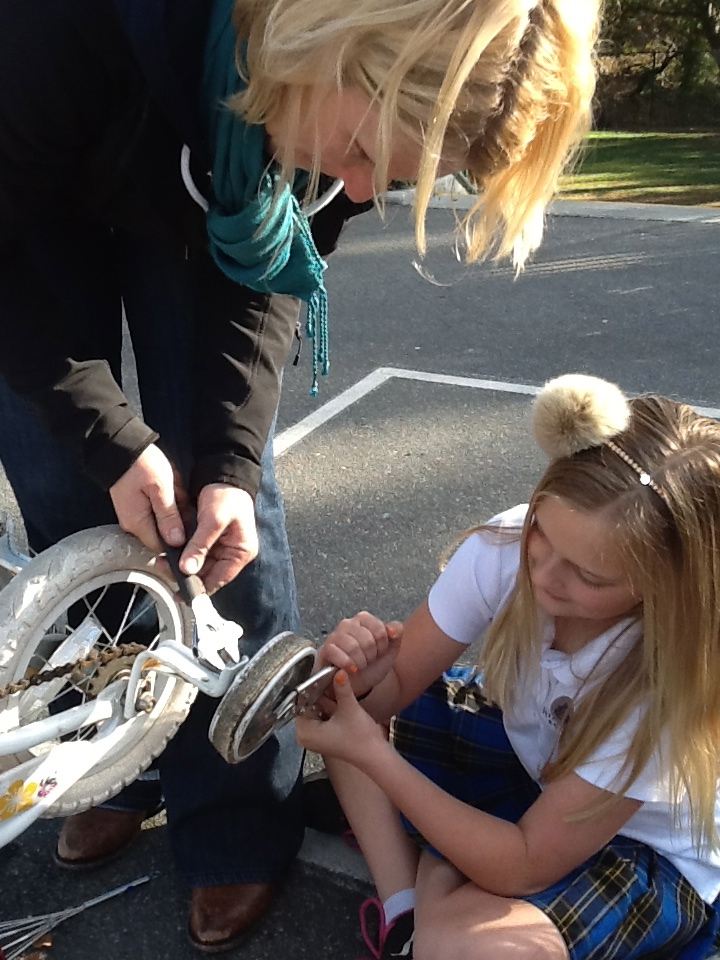
Part three of the project had students tinkering with ten donated old bikes. Using various found metal objects and the creative minds of 3rd graders (the class of 2019), the bikes began to take on a new purpose in life. Inspired by the found art sculptures of Louise Nevelson, an American artist from the early 1900’s, students observed pictures of her unusual art that she made from wood found on the streets of New York City. Nevelson used white, black, and gold to create an illusion of all the found objects coming together to seem as one creation. In the bike project, each bike was designated an intensely bright color as well as a musical tone. The color connected to the C scale – Red = C, Orange = D, Yellow = E, Green = F, Blue = A, Indigo = A, Violet = B. These bright colors were chosen to create an illusion of the found objects and the bike being one new and whole creation. Circling back to the science integration, each color also reflected low to high wavelengths in the electromagnetic spectrum.

Students dressed to match their tone for the outdoor bike concert.
Once the bikes were completed, Ms Engineer spent time with the students helping them to compose pieces of music using their new instruments. They learned many concepts of composition such as: dynamics (loud/soft), tempo (fast/slow), form (how a piece is structured), texture (how many sounds the layer), rhythm (layered repeated rhythms), melody (drone string), and timbre (the quality of the sound). They worked in groups of 3 and 4, learning the important skills of compromise, idea sharing and listening to one another in order to create one final piece of music. The final showcase of student work was a concert played for the entire school on our outdoor stage.
When asked how she was able to assess student growth during such an open ended project, Ms. Engineer simply stated, when the music works it works. The best kind of assessment is authentic for students and adults. In this case, the end product was a multi-layered work of art, informed by true science and the understanding of sound. Students would not have gotten very far without their ability to see the patterns between their work in science and their in music class. They also needed to learn how to listen to eachother’s ideas without judgement, the core principle in brainstorming and collaboration. One of the best forms of assessment notes Ms. Jones is when the kids forget if they are in music class or in science class because their approach to work naturally integrates the skills and concepts of both disciplines seamlessly.
The final stage of the project was to offer the entire Hillbrook community an interactive art installation on campus where all the students could make music with their friends and explore the sounds the bikes make. The synergistic effect of the bright colors, the whimsical and inventive sound making designs and the applied science that informed this project, is a joy to see on campus. The creative and hard working efforts of Ms Engineer and Ms Jones to bring beauty and understanding to our community is a perfect example of our school’s growing passion for experiential learning, the importance of play and integrating subject matter into real work. Gaining literacy through teacher/student directed research, as well as making with an emphasis on smart, sustainable design, authentically integrates science, technology, engineering, art and science in a way that feels, looks, and SOUNDS awesome!
Leave a Reply