The Awesome World of Making @ Hillbrook

Stories of Making and Constructionist Learning

Page 5 of 6

Applied Science Makes for Better Listening in 3rd Grade

At the Hillbrook school, art has been a vital part of our curriculum for decades. Now we have the collaborating team made up of Jenny Jones, 3rd and 4th grade science teacher, and Kristen Engineer, lower school music teacher, expanding student experiences into the realm of making music and musical instruments from found art. Read about each unique project here.

When a community loses a valued member and longtime contributor to community building events such as all school concerts, that transition can be a painful, yet hope-filled moment for reflection and growth.  When beloved music teacher Roberta Lipson retired the spring of 2013, we wondered how we would reconstruct our community in a way that reflected who we are as a school today, while cherishing the contributions of our past leaders. Our questions were answered in short order, when Ms. Kristin Engineer, long time colleague of our other beloved Hillbrook music instructor, Elizabeth Crabtree, came into our community in August. In true Hillbrook fashion, Ms. Engineer dared to take a risk and collaborate with lower school science teacher Jenny Jones on what I hope will be a long standing Hillbrook tradition to celebrate the uniquely human and deeply inspiring intersection between the arts and sciences. Engineer, new to our school, and Jones, new to a teaching position of 3rd and 4th graders (Ms. Jones taught grades JK-3 science previously at Hillbrook) decided to dedicate weeks of lesson time and hours of personal time over the weekends and breaks to realize their vision of this project.  And what a vision it is!

(photo credit: Arturo Bejar)

This project began with Ms. Jones introducing the science of sound in her 3rd grade classroom the first week of November. Step one offered a series of discovery labs in Ms. Jones’ room (labs designed to offer students structured exploration of materials and concepts), to allow students to explore the properties of sound. Concepts explored included vibration, wavelength, pitch and the anatomy of the ear. Allowing students to play their way through the learning process, Ms. Jones worked with her students as they gained a confidence in their understanding and by week two, the 3rd graders were ready to start applying that new understanding to their work in music class.

Part two in the collaboration entailed Ms. Engineer introducing the project by exposing students to the concept of pattern, texture, and dynamics while simultaneously tying in one of the core concepts of the project, sustainability and up-cycling (the method of taking what would be discarded as trash and repurposing it for a more valuable object then its original form offered).  Exploration of this concept came from creating found object art in the style of Andy Goldsworthy, an Irish photographer and artist who creates pieces of art from items found in nature.  The children used natural objects such as:  twigs, leaves, flowers, feathers, and rocks. Next, Ms. Engineer worked with the 3rd graders to compose simple musical pieces using recycled blue jeans to open their eyes to the possibility of making music not only with expected items, but with the unexpected ones as well.

The pieces that really brought it all together and connected the science/music was the color.  It takes the science of the color spectrum – applied to sound, and then uses this to tune the string element on the bikes to a particular note and painting them to reflect this choice.

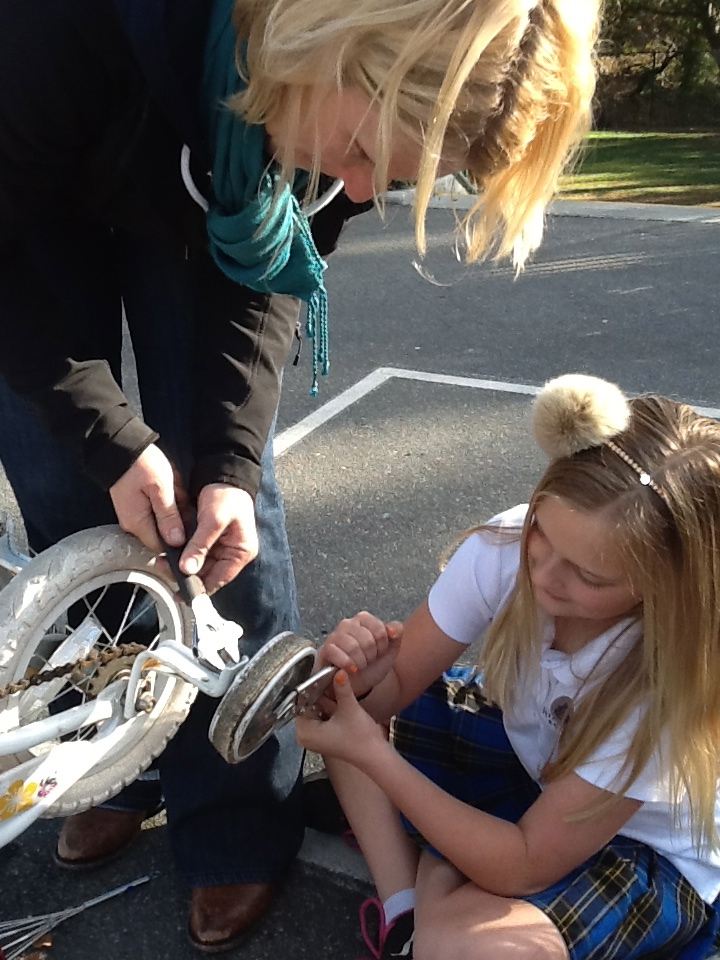
Part three of the project had students tinkering with ten donated old bikes. Using various found metal objects and the creative minds of 3rd graders (the class of 2019), the bikes began to take on a new purpose in life. Inspired by the found art sculptures of Louise Nevelson, an American artist from the early 1900’s, students observed pictures of her unusual art that she made from wood found on the streets of New York City.  Nevelson used white, black, and gold to create an illusion of all the found objects coming together to seem as one creation.  In the bike project, each bike was designated an intensely bright color as well as a musical tone.   The color connected to the C scale – Red = C, Orange = D, Yellow = E, Green = F, Blue = A, Indigo = A, Violet = B. These bright colors were chosen to create an illusion of the found objects and the bike being one new and whole creation.  Circling back to the science integration, each color also reflected low to high wavelengths in the electromagnetic spectrum.

Students dressed to match their tone for the outdoor bike concert.


Once the bikes were completed, Ms Engineer spent time with the students helping them to compose pieces of music using their new instruments. They learned many concepts of composition such as:  dynamics (loud/soft), tempo (fast/slow), form (how a piece is structured), texture (how many sounds the layer), rhythm (layered repeated rhythms), melody (drone string), and timbre (the quality of the sound).  They worked in groups of 3 and 4, learning the important skills of compromise, idea sharing and listening to one another in order to create one final piece of music.  The final showcase of student work was a concert played for the entire school on our outdoor stage.

When asked how she was able to assess student growth during such an open ended project, Ms. Engineer simply stated, when the music works it works. The best kind of assessment is authentic for students and adults. In this case, the end product was a multi-layered work of art, informed by true science and the understanding of sound. Students would not have gotten very far without their ability to see the patterns between their work in science and their in music class. They also needed to learn how to listen to eachother’s ideas without judgement, the core principle in brainstorming and collaboration. One of the best forms of assessment notes Ms. Jones is when the kids forget if they are in music class or in science class because their approach to work naturally integrates the skills and concepts of both disciplines seamlessly.

The final stage of the project was to offer the entire Hillbrook community an interactive art installation on campus where all the students could make music with their friends and explore the sounds the bikes make.  The synergistic effect of the bright colors, the whimsical and inventive sound making designs and the applied science that informed this project, is a joy to see on campus. The creative and hard working efforts of Ms Engineer and Ms Jones to bring beauty and understanding to our community is a perfect example of our school’s growing passion for experiential learning, the importance of play and integrating subject matter into real work. Gaining literacy through teacher/student directed research, as well as making with an emphasis on smart, sustainable design, authentically integrates science, technology, engineering, art and science in a way that feels, looks, and SOUNDS awesome!


The Hillbrook History House Begins!!

Hillbrook History House Project Progress Report #1:

Hello everyone, this is Katherine and Meghan with the first progress report. Our goal is to send out one progress report at the end of every week. The progress will include pictures of the project’s status. In our first nine classes we have established 6 different roles and this will explain each one.

Chaaya has assumed a very creative role and is constructing a documentary about the process of this long term project that will span two electives, perhaps an after school course and a few weekends to complete. The movie will also show our entire process step by step and explain each person’s roles throughout the project.

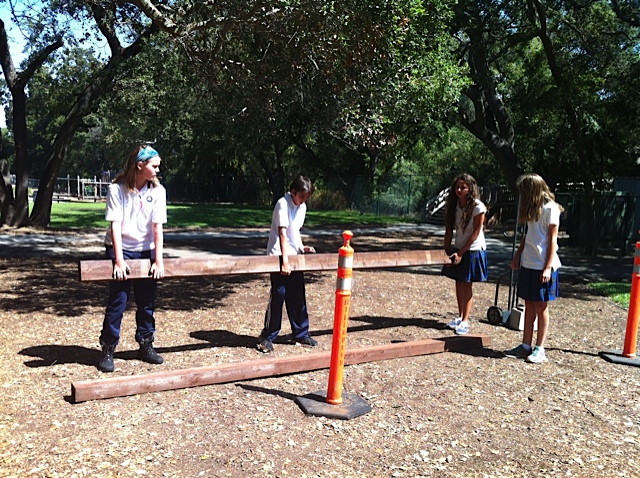
Isabel, Emma, Gaby and Lora, have been building a practice wall. This job is called framing or carpentry. The framing team finished the practice wall in only 8 classes. When we start to build the real walls, each of the original framers will assume responsibility for one wall of the house. She will then mentor and build that wall with the help of two other members each from the group.

Based off of scale drawings (see above) that taught the class the key terms of framing, Caryus finished the materials list that will need approval from our expert mentor carpenter, Tom Jameson. He will continue to work on the materials list for the floor and walls and future material needs, such siding and windows and doors.

During the past week Seamus has been working on a to scale, miniature, prototype of the exterior and interior of the house. Seamus is using CAD software and the laser cutter for this task. The interior will have a blueprint of what our plan is for the furniture once the house is built. Three dimensional buildouts of the interior features, such as counters, shelves and chairs will also be added later. The prototype will serve as a model to give others an idea of what the final house will look like once its complete.

Nevin has been working on a presentation explaining how applied geometry makes the building of the History House possible. Using the Pythagorean Theorem people can measure angles. It is essential that all the angles be spot on or else the walls will be unstable. Nevin will continue to work on this project to explain how geometry is used in many aspects of the house.

Lilah and Samantha have been working on the house’s foundation. The foundation consists of  four cement blocks with four 4 x 6 inch wooden beams on top of them. Lilah and Sam first needed to square the four main beams of the foundation. This was a great opportunity to practice the use of the pythagorean theorem. The next step was to level the whole 10 x 12 foot frame and nail the foundation together.

Next, the HHH team will be building the floor for the new structure and putting together the real walls for the house using their new framing skills.  Stay tuned!

Maker Faire, awesome authentic assessment for student work

Authentic Assessment:

Maker Faire and the Public Showcase of Work

Happy customers played the game “Exploring the Stars” by 5B endlessly all weekend.
Here a boy smiles as his friend waits impatiently by to get his turn.  


Less than 24 hours ago, the Hillbrook school spent the weekend at the Bay Area Maker Faire where hundreds of thousands of curious onlookers got to see the kind of work Hillbrook’s students are making in the school’s MakeSpace for applied technology, engineering, art, math and science (t.e.a.m.s.). Hours of energy, designing, testing and prototyping paid off, as students shared their work with the world and got to see the looks of amazement and joy as their games were on display.

Student at the Maker Faire making basic blueprint posters to represent
their teams individual project efforts and tinkering to get their machines
up and running.
 

While both machines arrived at the faire grounds Friday unfinished, students spent much of Saturday getting one machine up and playable. Once online, the game miraculously lasted all weekend under the heavy user testing environment of the Maker Faire with only one small repair issue by Sunday afternoon, a loose flipper. This testament of engineering by the class of 2017 is evidence that with enough time and hope, even kids can make something real, like a working pinball machine.

Hillbrook’s booth was in the Young Makers Expo Hall, along with other Bay Area schools such as the Menlo School, Nueva, Castilleja, Lighthouse Community  Charter, Athenian and East Bay School for Boys. Maker Faire not only gives students a place to share their work with like-minded inventors and scientists, it gives students a chance to practice their public speaking.  Above, 5th grader Haley explains the class project to interested players.  Historically (Hillbrook attended first in 2013) Maker Faire has been a right of passage for 5th graders but 6th graders have also used the venue for testing and showing the products they designed in problem based science level 6.

Below 6th grade student Claire shares her tactile memory game called “TextureTiles” with interested gamers at the Faire. She has been working on this game all semester as part of her requirement to research a problem and design a solution that addresses that problem. She chose the lack of educational games for the blind as her topic. Claire went above and beyond the yearly goal of doing two forms of active research for her product design by doing two additional forms of active research at Maker Faire. She attended the event on Saturday, felt she had some improvement to do on her experiment design and came back for a second round of testing on Sunday, this time with a bigger and more impressive set-up.

6th Grader Claire does product testing on site at Maker Faire on Saturday.

Maker Faire is an exciting platform for students to share and talk about their ideas and inventions. Maker Faire opens the doors for students into a community where they are accepted as smart, creative and cool. With adult help, students can also fill out the project application themselves as students from Lighthouse Community Charter School do.  Taking ownership over the process of showing work to the public is an extremely valuable skill for young makers to have and one we will create more space for in preparation for Maker Faire 2015!

6th Grader Claire continues product testing on site at Maker Faire with help from B.B. on Sunday, now with her poster board.

CitY3K: Ultimate Pinball Machine merges STEAM for the class of 2017

“What is a hard problem?”

I ask my 5th graders at the beginning of the spring semester what they think a hard problem is and various hands will go up. “You will fail a lot.” “Challenging” and “Something that takes time to solve,” are comments that my students freely share. From my perspective, the “teacher” in the room, a hard problem is one that I do not see the solution for clearly, a problem that will challenge my students to learn challenging skills in digital and analog tool use, geometry and scale, grit through a series of failures and collaboration. For the last two years, 5th graders have had the experience of working for an entire semester on one problem, defined by a few simple rules.  Last Spring, The class of 2016 built a RubeGoldBridge (RGB) that connected five different machines or structures into one large system that did work on a 75 gram steep ball.  This RGB was taken by last years 5th grade to Maker Faire, where their designs and team work earned them two awards!

One section of 5B’s RGB structure/system for Maker Faire 2013

This year’s 5th grade was challenged a step further. This years 5th grade is building a life size pinball machine with the design theme of a city in the year 3000!  Their problem consists of the following rules:

Level One: Pass/Fail Rules

  • Keep a 65 gram steel ball in motion for x number of seconds
  • using 2 or more forms of forces
  • bridging 3 or more forms of energy

Level Two: Pass with Honors

  • Demonstrate design elements that reflect an understanding of how humans will live in the year 3000. Must use a claim, evidence reasoning format to support the Science behind the ART
  • Build ONE complete system rather than smaller team units separately

To solve this problem we began in teams of 4 with a special team of electrical engineers (or the e-team) who had the most experience working with electronics in the first semester. Next we spent a week completing a circuit circus where students mentored and practiced building simple circuits, drawing circuit diagrams, using a multimeter and soldering. Next it was time to get busy building our real pinball machine.


As a special bonus, on March 3rd, pinball mechanic Christopher Kuntz of the Pacific Pinball Museum generously donated one working vintage pinball machine to the iLab for inspiration and research as well as non-functional machine for students to harvest parts from.  With a working set of flipper motors and tons of faith, we embarked on our spring hard problem.

To date, we have seven different teams formed in each class around passions to solve specific problems for the class game. We have teams of electrical engineers making the score boards using LED’s, Arduinos to process triggers, and systems of motors that will interact with the steel ball in the play field.  A team of structural engineers building the frame. An art history and research team researching the science behind the games artwork. Mechanical engineers working on the launcher mechanism and bumpers. Teams of students learning how to use CorelDraw for the laser cutter. There is also a sound engineering team using Makey Makey boards to include sound effects for the game.

Below you see how students are logging problems that are shared across their sections. The best comment I have heard yet from one member of the sound engineering team was, “They are looking in the log and stealing our ideas!” My response, “That’s wonderful! Congratulations on your working design.”


Binders teams use to keep their problem logs together

« Older posts Newer posts »